
Management campuses are expecting the rise in pre-placement offers to ease the final placement process.

Dr Ajay Kumar Sood will have to complete a task his predecessor started: Getting the government to sign off on a new Science, Technology, and Innovation Policy on which work was begun in 2020.

'IIM Ahmedabad has seen one of the best placement seasons ever and this change can be attributed to the markets opening up after the pandemic.'

Mutual funds (MFs) are set to be net sellers of Indian equities for the first time in the past seven financial years, having sold stocks worth about Rs 1.27 trillion so far in 2020-21 (FY21), making it the highest net sales on record in a financial year. MFs had been net buyers in the previous six financial years, including purchases of over Rs 1.41 trillion in FY18, Rs 88,152 crore in FY19, and Rs 91,814 crore in FY20. The last time they offloaded Indian equities was in FY14, when they net sold stocks worth Rs 21,159 crore. In contrast, foreign portfolio investors (FPIs) have ramped up buying in FY21, purchasing more than Rs 2.6 trillion worth of shares.

The average time lag between the date of occurrence of a fraud and its detection is 23 months; for large frauds (Rs 100 crore and above), it was 57 months.

Management institutes are putting in additional efforts to get more woman students on their campuses.

'Generic skills are in abundance, but technological advancements have left staple skills redundant.' 'It is why employers are now looking for alternate sources of hiring -- deploying gig workers, looking at Tier 2 and Tier 3 cities for relevant talent.'


After a sharp correction over the last few months, analysts seem to be turning cautiously optimistic on the information technology (IT) sector and suggest there could be trading opportunities in select counters despite revenue and growth concerns that still plague the sector. "IT stocks valuations have corrected 17 per cent-49 per cent and stock prices have corrected 9 - 42 per cent since mid-December 2021. Nifty IT index valuation has corrected by 27 per cent and price by 21 per cent. "About two quarters ago, we made a case that valuation drivers have peaked.

Independent directors

The Centre will promote Kisan Drones, chemical-free natural farming, public-private partnerships for the delivery of digital and high-tech services to farmers across the country during the financial year 2022-23, Finance Minister Nirmala Sitharaman said on Tuesday. Presenting the Budget 2022-23 in Parliament, Sitharaman said the inclusive development is one of the four priorities of the government moving forward. As part of the inclusive development, the government will promote the use of 'Kisan Drones' for crop assessment, digitisation of land records and spraying of insecticides. The government will also facilitate a fund with blended capital raised under the co-investment model through Nabard to finance agri start-ups and rural enterprises, she said.

Expressing commitment to augment the country's infrastructure, Finance Minister Nirmala Sitharaman on Monday proposed to significantly enhance capital expenditure to Rs 5.54 lakh crore in the next fiscal, besides creating institutional structures and giving a big thrust to monetizing assets to achieve the goals of the National Infrastructure Pipeline (NIP). Sitharaman said NIP, that was launched in December 2019 with 6,835 projects, has now been expanded to 7,400 projects and around 217 projects worth Rs 1.10 lakh crore under some key infrastructure ministries have been completed. "For 2021-22, I propose a sharp increase in capital expenditure and thus have provided Rs 5.54 lakh crores which is 34.5% more than the BE of 2020-21," the finance minister said.

They are witnessing, or anticipating, a double-digit growth in job offers over the same period last year.

Conventional wisdom is that when the US sneezes, emerging markets like India catch a cold. And yet the Indian stock market went up last year, points out Debashish Basu.

HR Guru Mayank Rautela offers practical advice.

Uncle Pai, as he was fondly called, inculcated in Indian children a love for and interest in India's glorious past and its heroes.

What's different this time is that global financial stress -- which has its genesis in four policy choices made in recent years -- is juxtaposed with a more resilient real economy, observes Sajjid Z Chinoy, chief India economist at J P Morgan.

Fund mobilisation by companies through equity and debt routes has dropped 20 per cent in 2022 to nearly Rs 11 lakh crore, as exuberance dwindled this year due to expensive credit avenues and volatile markets. The first half of 2023 could continue to remain challenging. The year 2021 was extraordinary for fundraising from the equity and debt routes, while 2022 has seen a slowdown in capital raising owing to elevated volatility provoked by unprecedented inflation globally and the Russia-Ukraine war.

If there was one event that made the month of August stand out, it was a strengthening of the dollar index to levels last seen only 20 years ago, as the Federal Reserve dispelled all doubts about its intention to continue raising interest rates. Predictably, most currencies suffered against the US unit, with the bulk of the losers belonging to the emerging markets pack. Amid the volatility, the rupee, however, has displayed significant resilience and fared much better than most of its peer currencies.

7 key areas that the Budget must address to re-energise the infrastructure sector, suggests Vinayak Chatterjee.

The government on Monday budgeted Rs 1.75 lakh crore from stake sale in public sector companies and financial institutions, including 2 PSU banks and one general insurance company, in the next fiscal year beginning April 1. The amount is lower than the record Rs 2.10 lakh crore which was budgeted to be raised from CPSE disinvestment in the current fiscal year. However, the COVID-19 pandemic impacted the government's CPSE stake sale programme, and the target has been lowered to Rs 32,000 crore in the Revised Estimates.

...Is this a virus more dangerous than Covid-19, asks Ajit Balakrishnan.

Domestic mutual funds (MFs) and foreign portfolio investors (FPIs) have been net buyers of stocks in August. Domestic fund houses have continued to invest in stocks, propelled by the success of various new fund offers (NFOs) and strong flows into equity funds. MFs had purchased stocks worth more than Rs 8,300 crore until August 23, according to the data provided on the Securities and Exchange Board of India (Sebi) website. Jimmy Patel, MD and CEO at Quantum AMC, says: "The surge in equity investments by MFs is because of two key reasons. One, equity NFOs are getting a strong response from investors, and fund houses need to deploy that money in the markets.
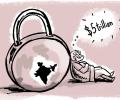
In order to achieve $5 trillion GDP by FY'25, India needs to spend about $1.4 trillion over this period on infrastructure, according to the Economic Survey. During financial years 2008-17, India pumped in about $1.1 trillion on infrastructure. However, the challenge is to step up infrastructure investment substantially, the Economic Survey 2021-22 said.

'Bottomline, hairline and waistline -- you have to watch them always.'

The biggest risk to India's growth outlook is an escalation of geopolitical tensions, especially if these tensions spread to the Asian region, RBI Monetary Policy Committee (MPC) member Jayanth R Varma said on Wednesday. Varma, in an interview to PTI, said that inflation and inflationary expectations appear to be moderating and high inflation will certainly not become the 'norm' in the country. He is cautiously optimistic about the Indian economy as after the pandemic abated, consumption demand has begun to recover though the recovery is uneven across sectors and industries.

As the world awaits the end of the global pandemic, rural Bengal might be witnessing a recession unfolding in bits and pieces. With factories and tea gardens closing down, agricultural income falling and storm Aila ravaging a large part of deltaic West Bengal in 2010, migration gradually became a norm.

Year 2021 was another great year for fund-raising through equities. A total of Rs 1.8 trillion was raised through initial public offerings (IPOs), qualified institutional placements (QIPs), and rights issues, against the Rs 1.7 trillion raised in the previous year. Funds raised through IPOs quadrupled, while those from rights issues and QIPs reduced.

The government on Monday published a draft data policy for public consultation, which says all data collected, generated, and stored by every government ministry and department will be open and shareable barring certain exceptions. Also, detailed datasets that have undergone value addition could be monetised by the government. The policy document, called "Draft India Data Accessibility & Use Policy 2022", prescribes that a regulatory authority called the Indian Data Council (IDC) and an agency by the name India Data Office (IDO) will oversee framing metadata standards and enforcement, respectively.

The Indian IT services sector is scrambling to retain talent since digitisation-led transformation has increased the demand for a digitally skilled workforce. As a result, the pull for jobs for tech professionals is also coming from non-IT sectors, leading to higher attrition among IT companies. The average number of tech jobs from non-IT sectors has seen a 41 per cent uptick in March-May'21 versus March-May'19, according to data from Naukri.com.

The government on Tuesday announced Rs 900-crore allocation in the Budget for the newly set up Ministry of Cooperation for the 2022-23 fiscal, besides slashing Alternate Minimum Tax (AMT) on cooperative societies to 15 per cent and surcharge to 7 per cent, which nodal minister Amit Shah hailed saying it will boost the sector. Of the total allocation for the next fiscal, a significant amount of Rs 350 crore has been provided for digitisation of Primary Agriculture Cooperative Societies (PACs), while Rs 274 crore for an umbrella scheme 'Prosperity through Cooperatives' which would have a number of sub-components with the aim of all-round development of cooperatives in the country. For the first time, a separate budget of Rs 11 crore has been provided to Vaikunth Mehta National Institute of Cooperative Management (VAMNICON).

Fundraising activity in the upcoming financial year 2022-23 may even surpass FY22 when 52 Indian companies raised a record Rs 1.11 trillion via initial public offerings (IPOs). According to a note by PRIME Database, 54 companies (including LIC) plan to raise Rs 1.4 trillion and currently hold the Securities and Exchange Board of India's (Sebi's) approval. Another 43 companies, the note said, are looking to raise about Rs 81,000 crore but waiting for Sebi nod.

'In 2022, active management, long-short strategies, multi-asset strategies, and asset allocation strategies need to be considered to meet long-term investment goals.'

Not being able to control outcomes and manage our own expectations leads to stress and anxiety which further leads to sadness and disappointment and worse case, depression.
A few students from the National Institute of Industrial Engineering (NITIE) tell us what they did in their last 20 days before CAT.

For development finance institution to succeed now, the government must stand like a rock behind it and be patient.

The Centre on Monday earmarked a separate Rs 2,217 crore for 42 urban centres to tackle air pollution and announced the much-awaited voluntary vehicle scrapping policy to phase out old and polluting vehicles, even as it shrunk the budgetary allocation for the environment ministry from the last fiscal by nearly eight percent. Union Finance Minister Nirmala Sitharaman, in her budget speech for 2021-22, announced a total of Rs 2869.93 crore for the ministry, Rs 230 crore less than the last fiscal. Officials said the outlay has been lesser this time as the economy is recovering from the COVID-19 pandemic.

'When an institution believes its knowledge and capability is superior to everyone, it behaves like a frog in the well.' 'And this is precisely the cause for the mess,' says J N Gupta.

'Hacking of an ID or an account will have the same impact on a user in a city and one in a small town.' 'Security is like a railroad, you create it to last for every customer.'

Tech is also being used to stem resignations, which have recorded a rise amid COVID-19.
